

Search is changing. People are no longer relying only on traditional Google search results to find information, products, and services. They are increasingly asking AI platforms such as ChatGPT, Perplexity, Claude, Gemini, and Google AI Overviews for direct answers.
This shift has created a new opportunity for businesses: Generative Engine Optimization (GEO).
While traditional SEO focuses on helping your website rank in search engine results, GEO focuses on making your website easier for AI systems to discover, understand, trust, and potentially cite in generated answers.
A GEO audit helps you identify whether your website is ready for AI-powered search and what you can improve.
In this guide, we will explain how to do a GEO audit of your website step by step, including how you can use the free Hyperclients GEO Score Checker to identify important technical and content gaps.
What Is a GEO Audit?
A GEO audit is a systematic evaluation of your website to determine whether AI search and answer engines can access, understand, extract, and trust your content.
A typical GEO audit looks at areas such as:
- AI crawler accessibility
- Robots.txt configuration
- llms.txt
- Structured data and schema markup
- Content that can be read without JavaScript
- Question-and-answer content
- FAQs
- Content structure
- Author and trust information
- Content freshness
- Sources and citations
These factors overlap with traditional SEO, but GEO adds specific considerations related to AI search visibility.
Looking for a faster way to find high-intent prospects? Learn how a LinkedIn lead generation tool can help you discover and connect with potential clients.
Why Should You Perform a GEO Audit?
Ranking well on Google does not automatically mean your website will be cited by AI answer engines.
AI systems need to be able to access your content and understand what your pages are about before they can potentially use them as sources.
A GEO audit can help you identify:
- Whether AI crawlers can access your website
- Whether important pages are easy for AI systems to understand
- Whether your content contains clear answers to common questions
- Whether your structured data accurately describes your content
- Whether important trust signals are present
- Whether your website has an llms.txt file
- Which GEO improvements should be prioritised
It is important to remember that a GEO score does not guarantee AI citations. A high technical score means your website is more accessible and understandable, but citation decisions can also depend on the usefulness, specificity, authority, and relevance of your content compared with other sources.
If you are a video editor looking for more clients, finding the right prospects can be challenging. Here’s how you can use effective strategies to find high-quality video editing clients and turn them into long-term projects.
How to Do a GEO Audit of Your Website
You can perform a GEO audit manually, but using a GEO audit tool can make the initial technical checks much faster.
Check Your Current AI Visibility
Before making changes, establish your current baseline.
Create a list of questions that your potential customers may ask AI tools.
For example, if you run an SEO agency, your questions could include:
- What is SEO?
- How does technical SEO work?
- What is the difference between SEO and GEO?
- How can I improve my website's AI visibility?
- What is the best GEO strategy for a B2B website?
Test these questions across AI platforms such as ChatGPT, Perplexity, Gemini, Claude, and Google AI search features.
Record:
- Whether your brand appears
- Whether your website is mentioned
- Whether your website is cited
- Which competitors are appearing instead
- Which pages are being cited
This gives you a baseline that you can compare against after implementing GEO improvements.
Here are the key steps.
Step 1: Run Your Website Through the Hyperclients GEO Score Checker
The easiest way to start your technical GEO audit is with the Hyperclients GEO Score Checker.
Try the Hyperclients GEO Score Checker
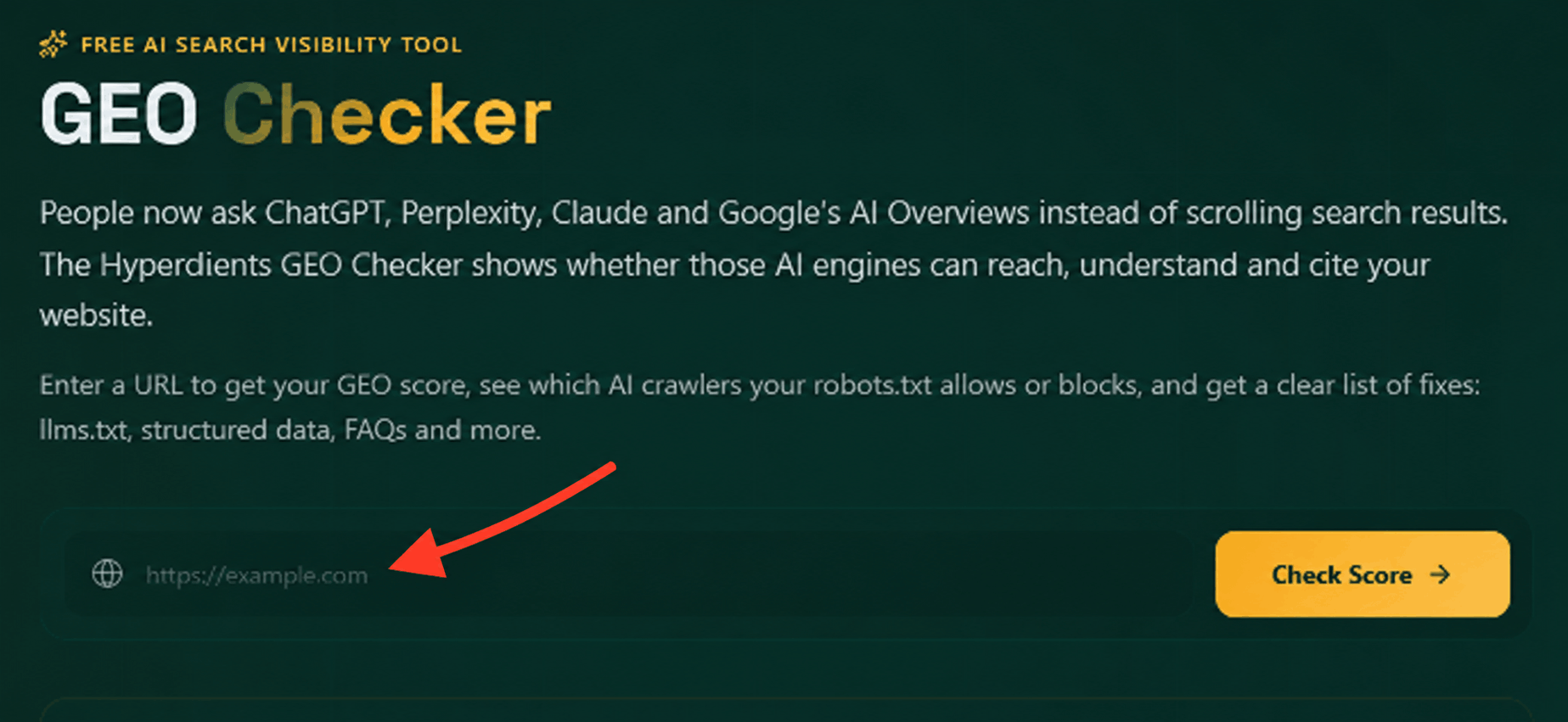
Open the Hyperclients GEO Score Checker and enter the URL of the website or page you want to audit.
Step 2: Run the GEO Check
Click Check Score.
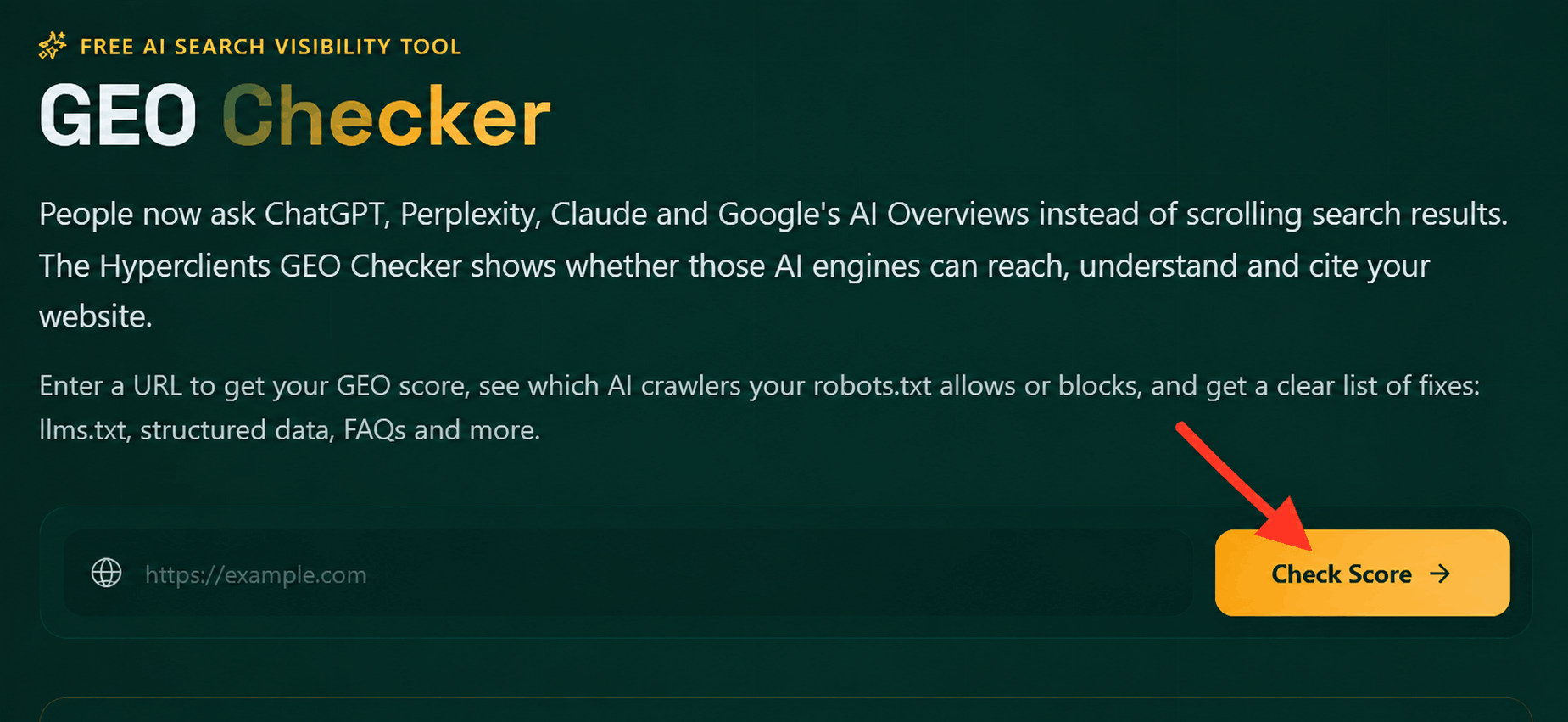
The tool will analyse your website and evaluate several GEO-related signals.
Step 3: Review Your GEO Score
The results show your overall GEO score along with specific areas that may need improvement.

Instead of looking only at the final score, review each individual recommendation.
Step 4: Identify the Issues

The checker highlights areas such as:
- AI crawler access
- llms.txt
- Structured data
- Content accessibility
- FAQs
- Question-based headings
- Answer-friendly content structure
- Trust and freshness signals
Step 5: Fix the Issues
Use the recommendations to make improvements to your website.
Step 6: Run the Audit Again
After implementing the changes, run the website through the checker again.
This allows you to compare the results and identify whether the technical improvements have increased your GEO readiness.
If you run a local business and are struggling to attract customers through Google, these signs may indicate that your business needs to invest in SEO services to improve its online visibility and reach more potential customers
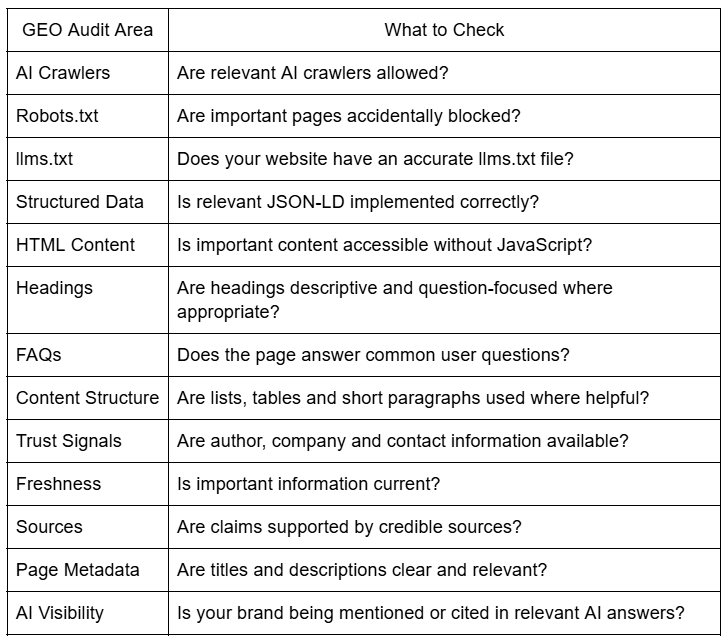
GEO Audit Checklist
Use this checklist when auditing your website:
GEO Audit vs SEO Audit
GEO and SEO should not be treated as completely separate strategies because they share several important foundations, including crawlability, technical accessibility, structured content, useful information, and a well-organized website structure. A traditional SEO audit helps identify issues that can affect your visibility in search engine results, while a GEO audit focuses on how effectively AI systems can discover, understand, evaluate, and potentially cite your content. Although both audits examine some of the same technical and content elements, they serve different search visibility goals.
In simple terms, SEO asks, “Can my website rank prominently in search results?”, while GEO asks, “Can AI systems find, understand, trust, and potentially cite my website when generating an answer?” As search behaviour continues to evolve, businesses should consider both approaches. Combining strong SEO fundamentals with GEO-focused improvements can help create a website that is accessible to both traditional search engines and AI-powered search experiences.
Are you ready to level up for Visibility?
GEO is becoming an important part of modern search visibility. As users increasingly turn to AI platforms for answers, businesses need to think beyond traditional rankings and consider whether their content is accessible, understandable, useful, and trustworthy enough to be considered by AI answer engines.
A GEO audit gives you a practical starting point.
Check your current AI visibility, audit your technical accessibility, improve your content structure, strengthen trust signals, and measure your progress over time.